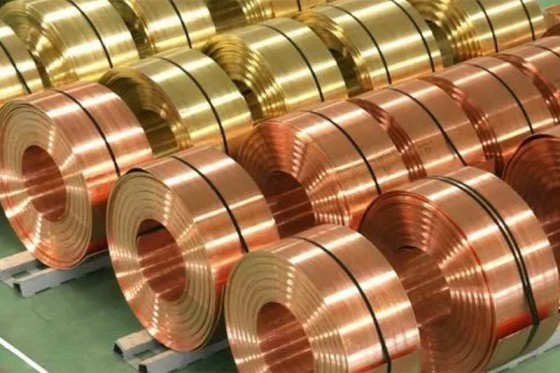
In 2015, when the fundamentals are still difficult to reverse, the launch of the the Belt and Road strategy seems to have brought dawn to copper's turnaround - can the strategy of power construction output activate the copper market?
Copper price recovery
Data shows that at the beginning of 2015, the largest decline in copper markets both domestically and internationally approached 15%, but since the end of January, copper prices have rebounded significantly. So far, copper prices have rebounded by 10%, with LME copper prices returning to around $6000 and domestic copper prices also returning to around 43000 yuan.
Looking into the reasons, in terms of demand, the poor performance of downstream industries is the dominant factor. According to data from Aowei Cloud Network, at the beginning of 2015, the downstream copper consumption industries of air conditioning and cables experienced a significant year-on-year decline.
However, history is always worth learning from. As in the past two years, economic weakness and excess copper fundamentals were the main reasons for the significant drop in copper prices at the beginning of the year. But with the gradual introduction of government policies to stabilize growth, copper prices will experience a recovery.
After the sharp drop in copper prices in early 2015, the launch of QE in the eurozone and the reduction of China's reserve requirements injected vitality into copper again.
On the supply side, due to the decline in copper prices at the beginning of the year, the spread of panic has led to the occurrence of situations such as smelter maintenance and reduced production, and the complete cessation of scrap copper supply. This has provided some room for the consolidation of copper inventory and formed a good support for copper prices.
The change in LME holdings also confirms the recovery of investment sentiment. On March 11th, LME Copper continued to increase its holdings by 3000 to 348000, which is at a historically high level.
Competition for pricing power
At present, China is the world's largest consumer of metals, with a copper demand of over 8 million tons per year, accounting for nearly half of the total global copper consumption.
Like iron ore, China has a high degree of external dependence on copper, with half of it relying on imports. But China does not have a global trading product, trading market, and delivery warehouse, which directly puts us in a very passive position in terms of pricing power.
Yang Li, Vice President of Jiangsu Dayuan Yintai Precious Metals Spot Electronic Trading Market, stated that the establishment of a bulk commodity delivery warehouse is extremely important for the development of China's bulk commodity market and the pursuit of pricing power for bulk commodities.
Internally, the establishment of a delivery warehouse will provide a safer guarantee for China's commodity consumption. Due to China being the world's largest consumer of metals, when there is an oversupply of bulk commodities worldwide, they will try to choose to ship them to warehouses located in China as much as possible. However, when there is a shortage of domestic demand, they can also purchase goods from warehouses in China nearby. In this way, the transaction costs of many metals will be greatly reduced.
To outsiders, the implementation of the the Belt and Road strategy in 2015 is bound to drive the export of infrastructure capacity. Among them, the laying of facilities such as electricity and railways will bring a large demand for copper, while China's own commodity exchanges and delivery warehouses will greatly reduce export costs and shorten the time and distance between countries along the route and our country.
Once copper exchanges such as LME are established, spot trading, bank pledge financing, and insurance allocation services centered around copper will become more mature and developed. The prosperity of the market will also be conducive to the competition for international pricing power, further enhancing the position of Chinese copper in the global commodity pricing system.
Benefiting from electricity investment
On February 7, 2014, a joint venture formed by State Grid Corporation of China [Weibo] and Brazilian National Electric Power Company with a shareholding ratio of 51:49 successfully won the bid for the Brazil Beautiful Mountain Water Electric Ultra High Voltage DC Transmission Project.
According to the 2015 investment plan of State Grid Corporation of China, the company's power grid investment in 2015 will reach 420.2 billion yuan, a year-on-year increase of 24% compared to 338.5 billion yuan in 2014.
Among them, investment in ultra-high voltage is considered a key focus, and the company plans to approve the construction of a total of 14 ultra-high voltage lines, including six crossings and eight straight lines, in 2015.
The strong investment of State Grid Corporation of China will undoubtedly benefit the increase in copper demand. Data shows that in 2014, China's consumption of refined copper was about 8.7 million tons, of which nearly half was used in the power sector. Antaike Consulting believes that State Grid's investment plan will stimulate an 8.7% increase in copper demand.
Citigroup analyst Ivan Szpakowski also stated that China is the largest copper demander, and State Grid is the country's largest power grid operator and the world's largest copper consumer. The company's demand for copper accounts for about 16% of the world's total, and its large-scale investment in power grid construction clearly sends a signal of rising copper demand in 2015.
Therefore, Citigroup predicts that copper prices will rise from the current around $5700 per ton to around $7000 per ton in the second half of the year.